
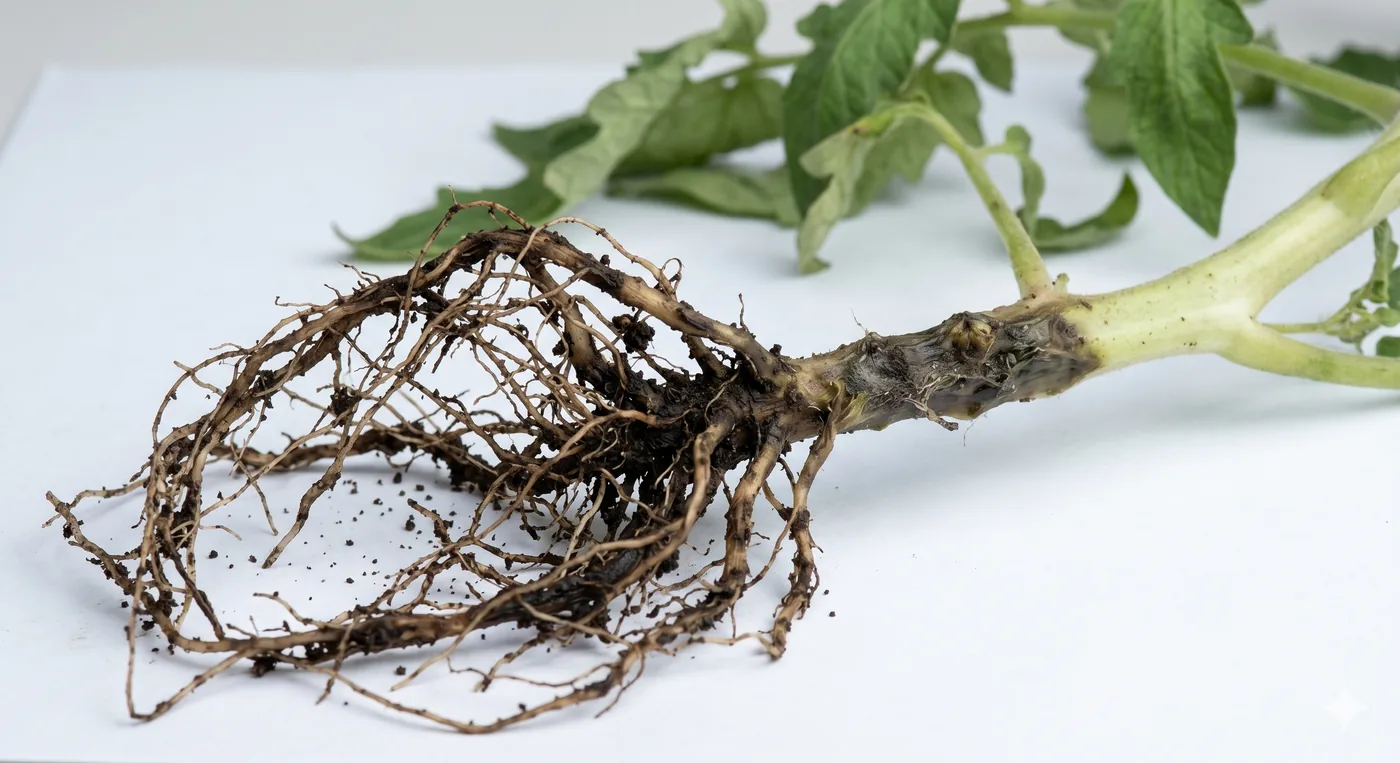
The most common mistake in greenhouse disease management is treating problems above ground that originate below it. Saturated, compacted, or high-EC substrate creates the root stress that makes crops vulnerable to pathogen attack. Prevention is always more effective, and less costly, than treatment. The substrate is where prevention begins.
Botrytis Cinerea — Grey Mould
Botrytis cinerea is the most economically significant fungal pathogen in greenhouse horticulture worldwide. It affects virtually every commercial crop — tomato, strawberry, cannabis, cucumber, ornamentals — and is responsible for substantial yield and quality losses every season, particularly in soft fruit and late-season production.
Botrytis is a necrotrophic pathogen, meaning it feeds on dead or dying plant tissue as its primary nutrient source before spreading to healthy plants. Dead leaves, old flower petals, and soft dying stems in the canopy are its primary launch points.
The conditions it requires
- Relative humidity above 85% — with peak risk above 93%
- Temperatures between 17–23°C — optimal sporulation range
- Still air at canopy and fruit level — no movement means spores settle and germinate
- Dead or dying tissue in the canopy for initial colonisation
- Substrate that retains moisture at surface level, elevating local humidity at crown and stem base
What you'll see before you see grey mould
The grey powdery sporulation appears only when infection is already well advanced. Earlier warning signs include water-soaked lesions on stems, petioles, or fruit; soft brown collapse at crown level in strawberry after humid periods; circular pale lesions on tomato fruit at the calyx; and in cannabis, brown discolouration inside dense flower buds ('bud rot') before any external signs.
How substrate management helps
When drainage is poor and surface moisture remains high between irrigations, the microclimate at crown and canopy level stays humid — even when your ambient RH sensors show acceptable readings. Moisture measurements at ridge or gutter level don't capture what's happening at plant base.
- Ensure substrate drains completely within 30–45 minutes of each irrigation
- Allow 10–15% drydown between irrigation events — the surface should lighten visibly
- Position drainage slits to prevent pooling at bag base
- Open greenhouse vents at sunrise — morning is when overnight moisture must be cleared
- Run horizontal airflow fans at canopy and fruit level
- Remove dying leaves and spent flowers regularly — they are Botrytis's entry point
Root Rot — Pythium & Phytophthora
Root rot in greenhouse substrate systems is primarily caused by water moulds of the genera Pythium and Phytophthora. Unlike true fungi, these are oomycetes — organisms that produce motile zoospores capable of swimming through water films to infect root tissue.
This zoospore mobility is critical to understand: the pathogen cannot spread without water to move through. Substrate that drains to adequate air-filled pore space removes the swimming medium and effectively contains the pathogen.
The conditions it requires
- Substrate saturation — air-filled pore space below 15%
- Root zone temperatures below 14°C — reduces root immune response
- EC stress — osmotic pressure weakens root membrane integrity
- Recycled irrigation water without UV or filtration treatment
- Anaerobic conditions from compacted or chronically over-irrigated substrate
What you'll see early
Root rot is particularly dangerous because its early symptoms are easily misdiagnosed as nutritional deficiencies. Plants wilting during daytime despite wet substrate is the most diagnostic early sign. Root tips browning when bags are opened, stunted growth with no visible foliar deficiency, and a foul or fermented odour from drainage water are all early indicators.
The diagnostic mistake most growers make: adding more water or more nutrients when they see wilting and slow growth. With root rot, both responses make the problem worse.
How substrate management helps
The single most effective prevention measure is maintaining adequate air-filled pore space at root level. A substrate that drains to 25–35% air-filled pore space within 30 minutes of irrigation will not support zoospore motility.
- Choose substrate with structural stability that maintains pore space under root pressure across the full season
- Never allow substrate to remain fully saturated for more than 60 minutes after irrigation
- Monitor root zone temperature with a substrate probe — bag temperature can differ from ambient by 8–12°C in early spring
- Open 2–3 bags per block every 4 weeks and examine root tip colour
- If using recycled irrigation water, implement UV sterilisation or chlorine dioxide treatment
Powdery Mildew
Powdery mildew is caused by obligate biotrophs — pathogens that require living host tissue to grow. Unlike Botrytis, powdery mildew thrives in dry conditions with moderate to high temperatures, making it a warm-season problem rather than a high-humidity one. However, water stress from substrate management problems can weaken plant immunity and increase susceptibility significantly.
The conditions it requires
- Temperature fluctuations between 20–30°C — optimal for spore germination
- Low relative humidity at leaf surface (below 50% RH can favour spread)
- Water stress — pronounced wet/dry cycles weaken cuticle integrity
- High nitrogen programmes — lush, soft vegetative growth is most susceptible
- Dense canopy restricting air movement
Prevention
- Maintain consistent substrate moisture — avoid pronounced wet/dry stress cycles
- Balanced nitrogen management — avoid excessive vegetative growth stimulus
- Stable growing environment — large temperature swings favour establishment
- Regular canopy management — lower leaf removal improves airflow
- Preventative biocontrol: Ampelomyces quisqualis or Bacillus subtilis applied from early season
Fusarium Crown & Root Rot
Fusarium oxysporum and Fusarium solani are soil-borne pathogens that infect roots and crown tissue, blocking vascular bundles and causing wilting, yellowing, and plant death. In coco substrate systems, they are introduced primarily through infected transplants, contaminated tools, or contaminated water sources.
The conditions it requires
- Root zone temperatures above 28°C — Fusarium sporulation accelerates significantly
- Contaminated transplants or soil residue on tools
- Recycled water without sterilisation
- Wounds at crown level from pruning
- Reuse of substrate bags without sterilisation
Prevention
- Source transplants from certified, disease-free propagators only
- Tool sterilisation between plant rows — 70% isopropyl alcohol or 1% sodium hypochlorite
- UV or chlorine dioxide treatment of recycled irrigation water
- Root zone temperature monitoring — keep below 26°C throughout the season
- Never reuse substrate bags without confirmed sterilisation
The Substrate's Role — Summary
Every disease in this guide is influenced — directly or indirectly — by substrate quality and management:
| Disease | Substrate Connection | Key Substrate Action |
|---|---|---|
| Botrytis | Poor drainage → elevated surface moisture → increased canopy RH | Fast surface drainage reduces local humidity at plant base |
| Pythium / Phytophthora | Saturation → zero air pore space → zoospore motility enabled | 25–35% air-filled pore space after drainage eliminates water films |
| Powdery Mildew | EC stress → weakened cuticle → reduced immune response | Consistent EC management prevents osmotic stress |
| Fusarium | High root zone temperature → accelerated sporulation | Well-aerated substrate maintains lower, more stable root zone temperature |
Weekly & Monthly Prevention Checklist
Daily
- ☐ Confirm substrate drainage is complete within 30–45 minutes of final irrigation
- ☐ Record canopy-level RH at sunrise and at 14:00
- ☐ Check substrate temperature probe reading
- ☐ Walk one full row per section for visual inspection
- ☐ Confirm horizontal airflow fans are operational
Weekly
- ☐ Measure and compare input EC vs runoff EC
- ☐ Measure runoff pH from at least 5 bags per block
- ☐ Open 2–3 bags and inspect root tip colour and distribution
- ☐ Canopy sweep for water-soaked lesions and early Botrytis indicators
- ☐ Confirm ventilation schedule is timed for sunrise
- ☐ Check drainage slit patency on a sample of bags
Monthly
- ☐ Test recycled irrigation water for Pythium/Phytophthora (if applicable)
- ☐ Compare current batch substrate data against initial specification
- ☐ Full canopy hygiene audit — remove all dead leaf material and organic debris
- ☐ Inspect drainage gutters and channels for root incursion or algae accumulation