
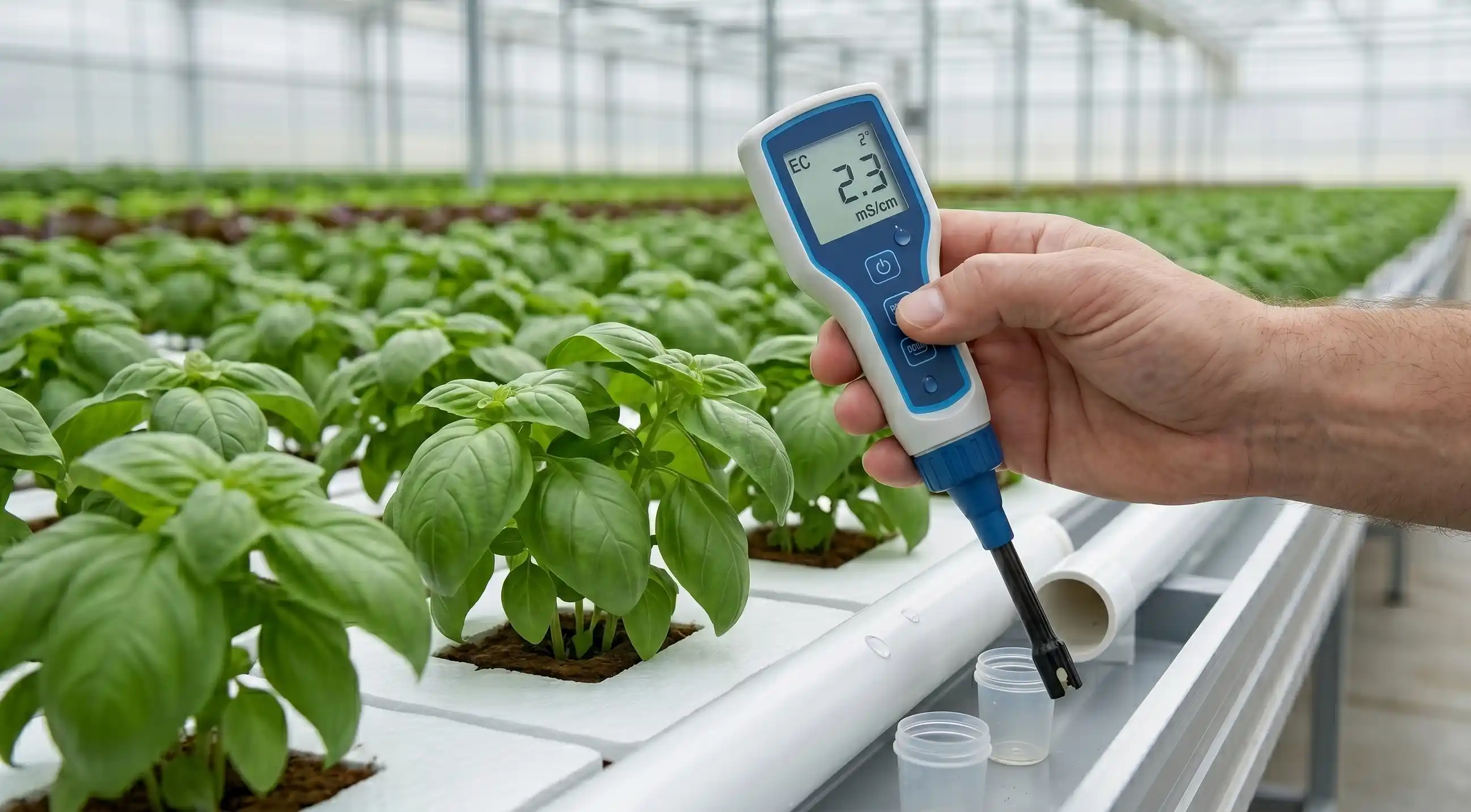
In automated commercial greenhouse setups, precise control over the fertilizer solution is critical. Unlike recirculating hydroponic systems, run-to-waste (RTW) systems rely on fresh, precisely dosed nutrient mixes delivered to the plant at scheduled intervals, with a specific volume of solution allowed to drain away. Coco coir is ideally suited to RTW setups, but requires continuous tracking of input vs. runoff EC and pH.
Managing Runoff EC (Electrical Conductivity)
Runoff EC provides a direct readout of the salt levels accumulating inside the slab root zone. If the plant absorbs water faster than it absorbs nutrients, the salts in the coir build up, raising the EC. If EC spikes too high, it exerts osmotic pressure on the roots, making it harder for the plant to draw moisture, resulting in tip burn and blossom end rot.
To control EC, target a daily runoff percentage of 20% to 30%. If your slab EC begins to climb:
- Increase the frequency of your irrigation cycles (applying shorter, more frequent shots to keep the slab flushed).
- Slightly lower the EC of your input feed (e.g. dropping from EC 2.2 to EC 1.8) for 24-48 hours.
pH Control and Nutrient Availability
The optimal pH range inside the coir rhizosphere is 5.5 to 6.2. In this range, macro and micronutrients are fully soluble and available to the root system. If the pH climbs above 6.5, essential metals like iron, manganese, and zinc precipitate out, resulting in interveinal chlorosis (yellowing leaves).
Because coir has organic Cation Exchange Capacity (CEC), it acts as a mild buffer, helping to stabilize root zone pH against sudden swings. However, if your feed pH is consistently outside the optimal zone, this buffering capacity will eventually be overwhelmed. Continuously calibrate your pH dosers and measure runoff pH daily.
Circumspect Dosing & Flush Cycles
Every two to three weeks, commercial growers should run a light flush cycle using a low-strength nutrient solution (EC 1.0) with standard pH. This clears out accumulated sodium, chloride, and excessive sulphate ions, resettting the media chemical balance for the next cropping phase.